


Entry tags:
application ( entranceway )
Name: Anne
DW username:![[personal profile]](https://www.dreamwidth.org/img/silk/identity/user.png) trustme_imthe
trustme_imthe
E-Mail: tavrosno(at)gmail(dot)com
IM: I prefer not to be contacted via AIM, please!
Plurk:![[plurk.com profile]](https://plurk.com/favicon.ico) porphyrogene
porphyrogene
Other Characters: N/A
Character Name: Giorno Giovanna
Series: Jojo's Bizarre Adventure ( Part V : Vento Aureo )
Timeline: Two months post-Vento Aureo, four months before the events of Purple Haze Feedback.
Canon Resource Link: Giorno @ Jojowiki
Character History:
Abilities/Special Powers:
Third-Person Sample:
First-Person Sample:
DW username:
trustme_imtheE-Mail: tavrosno(at)gmail(dot)com
IM: I prefer not to be contacted via AIM, please!
Plurk:
Other Characters: N/A
Character Name: Giorno Giovanna
Series: Jojo's Bizarre Adventure ( Part V : Vento Aureo )
Timeline: Two months post-Vento Aureo, four months before the events of Purple Haze Feedback.
Canon Resource Link: Giorno @ Jojowiki
Character History:
tw for discussion of child abuse/neglect, drug use/abuse, torture, body horror
Because everything in the Jojo's Bizarre Adventure universe builds on itself, and the story arc in which Giorno plays a protagonist's role is the fifth of six in the original universe, I am unfortunately going to have to go back one hundred actual years to start Giorno's story. However! I will do my best to keep my Victorian vampire story brief and get to the meat of the material as efficiently as possible.
DIO THE INVADER: 1880 — 1989.Giorno's father, Dio Brando, was born on an unknown date in the 1800s, probably somewhere around 1868. His father, Dario, went to loot a nobleman's crashed carriage one night, and said nobleman, being an idiot, thought Dario was trying to save his family. That nobleman was George Joestar I, and being a gentleman, he told Dario that he owed the man a debt, despite Dario being from London slums and the enormous difference in their social standing.
Dario, however, was not a gentleman. Dario was a drunk and an abuser, and it wasn't long after this encounter that he essentially worked his wife to death, leaving their son, Dio, to bear the brunt of his abusive behavior. The only kindness Dio was ever shown was at his mother's hand, and with her death at the hands of Dario, Dio's resolve to escape his situation and gain power was hardened. He slowly poisoned his father to death at the tender age of twelve and went to claim that favor from the Joestar family, with the ultimate intention of being adopted into the family and usurping the true heir's place.
That true heir, Jonathan Joestar, was about as different from Dio as could be imagined: sheltered, naive, kind, and clumsy, he aspired to be a true gentleman. Dio's sudden presence in his life turned it upside-down, as Dio isolated him from family, friends, romantic interests, and his dog (which Dio gruesomely killed). However, Jonathan could never prove Dio's awful behavior to his father, so he grew up with Dio as his brother, despite his extreme misgivings.
And that's the first episode of Jojo's Bizarre Adventure.
As the two of them grew to adulthood and entered college, Dio began to poison George very slowly, just as he had done to Dario. However, Jonathan is not an idiot; he realized that Dio wouldn't let anyone else serve George his "medicine", and when he confronted Dio about it, his adoptive brother admitted without a single ounce of remorse that, yeah, I was gonna kill your dad, what about it? Jonathan, being understandably upset, went to the police, while Dio got drunk and investigated an artifact in the Joestar study: a stone mask of unknown origin. He tested it more or less by accident on some other guys, and all of a sudden we all took a sharp left turn into a Bram Stoker novel, because they absolutely became vampires. So that happened.
Dio was faced with a choice, at this point: he could go to prison for poisoning George Joestar and lose everything he'd worked for . . . or he could take this previously-unknown option of discarding his humanity entirely, gaining power beyond belief and leaving behind a reality in which he could be hurt by anyone. Naturally, he chose the latter, and decimated the police force brought to take him in. Then he killed George. Then he tried to kill Jonathan and burned the Joestar mansion down in the process. Sure, it wasn't his original plan, but it's generally fine.
Jonathan escaped this whole mess, but unfortunately so did Dio. This put Jonathan in the position of having to defeat his cunning, amoral adoptive brother in an effort to not only avenge his father but protect the world from Dio's machinations, and with the help of a few people more worldly and dangerous than him, he endeavored to do just that. It wasn't easy, and A Lot Of Awful Shit happened, but in the end he managed to behead Dio, destroy his body and the mask, and marry his childhood sweetheart just in time to head on a honeymoon to the Americas. A happy ending!
Yeah, no.
Dio had plenty of devoted followers, and one of them managed to sneak his severed-but-still-functional head onto the ship Jonathan was traversing the Atlantic in. Why? Because Dio had decided he admired Jonathan enough to steal his body and use it as his own, which is a thing vampires can do in JJBA because none of the rest of this is awful enough. Jonathan manages to get his wife, Erina (who is pregnant, unbeknownst to him), off the ship, then destroys it in an effort to kill Dio once and for all — but unfortunately, he is the only one who dies, and Dio takes his body after all, crawling into a coffin and sinking to the bottom of the sea for nearly a century.
Then some fisherman pull up the coffin and let him out. Which is great for Dio, bad for the 80s — not to mention bad for Jonathan's descendents, but we'll get to that. In the meantime, Dio picks up where he left off as though a century hasn't passed, gathering followers (both willing and unwilling) to his cause and spending years working on his plans for world domination. Also having a good time! The 80s are great! Women wear pants, there's glitter everywhere! He updates his wardrobe. A good time. Not to mention eating a lot of people, and having an impressive amount of sex. One time he got together with a woman who was in Cairo from Japan, last name Shiobana, and he thought she was just mean as a snake . . . but we'll come back to her.
Suffice it to say, Dio's obsession with the Joestars was his undoing in the end, as one might expect. Despite causing an unbelievable amount of carnage and general damage in his wake, he was brought down in 1989 by a punk-ass teenager wearing a stupid hat, because Dio made his mom sick by waking up his Stand, and you just don't mess with a guy's mom. You just don't. The members of his cult of personality who were still alive mourned, but his son didn't. His son never met him.
His son was having a hard time.
HARUNO SHIOBANA: BIRTH — GANGSTER.Haruno Shiobana was born in 1985 in Japan, to a mother whose first name is never given for reasons that remain inexplicable. From the start, his life was difficult and unpredictable. His mother never wanted him; what she had anticipated as a no-strings-attached hookup was, in fact, an interview with a vampire, who proceeded to inform her that should she get pregnant from their sexual encounter, she should keep it — or he'd know. She didn't want a child; she didn't want attachment of any kind. She was young and eager to see the world. She wanted to party. So she left her infant son alone for hours, sometimes days at a time, forcing him to fend for himself long before he could even talk, let alone get around her apartment on his own.
Haruno's childhood was one of extreme neglect — at best, and to start with. Because after a while, his mother decided she was interested in a relationship after all, and married an Italian man with the last name Giovanna. She uprooted Haruno from Japan to Italy, changed his name to Giorno Giovanna, and then proceeded to not change her behavior very much at all. The attention she paid to him was still minimal, but now his life had the additional complications of a total relocation, having to learn a new language and culture, and, of course, a violently abusive stepfather.
Signor Giovanna was not interested in having Giorno around. It appears that he didn't really sign up for that. So he beat Giorno regularly, with little to no provocation, in addition to the neglect Giorno faced from his mother. The end result of all of this was that Giorno's self-esteem was nonexistent. He had no positive feelings about himself. He knew he was a victim — of his stepfather and, increasingly, of gangsters in the Neapolitan streets — and the only way he knew to cope with it was to curl up and freeze. He knew no love, only violence, and he could not conceive of a world in which he was worth loving.
Until one day, Giorno was walking down the street and came across a man lying bloodied and beaten in a patch of grass. He didn't understand what he was looking at, but when a few other men came around asking if he'd seen a man fitting that description around, instinct told him to lie. So he did — and then, quite by accident, his Stand activated, growing the grass around the injured man tall enough to conceal him from view. His Gold Experience's first act was one of protection, but notably not of himself.
The man he'd saved happened to be a prominent member of the local mafia, and just as George Joestar had rewarded Dario Brando for what he interpreted as bravery, so this unnamed gangster swore to pay back his debt to Giorno. He did this by, essentially, smoothing out the cracks in Giorno's life: local thugs no longer bothered him, his stepfather left him alone, and people in the city began to extend small kindnesses to him, giving up seats on the bus, talking to him, or even trying to be friends. Giorno was canny enough to realize this was all, on some level, false; on the other hand, this was the only kindness he'd ever seen in his young life, and as such he latched onto it with a desperately tight grip. To him, law-abiding society was where danger lay; the mafia, while a flawed system, had the power (with some reform) to be an unbeatable force for good in Italy, with the strength to protect those who, like him, were weak and without recourse.
So Giorno found himself a dream: to become the capo di tutti capi, the don, the supreme leader of Passione, the crime family of Napoli**. It's important to note that while his ultimate intention was to reform Passione, especially with regards to the drug trade (which he found reprehensible), he did not intend to do away with it, nor to remove its hooks from the Italian economy and government. His goal was, quite simply, to become a criminal and use that incredible criminal influence to push social reform — or else. Both idealistic and very scary, and this is all before his voice breaks.
Giorno appears to have spent most of his preteen years fussing with the details of this plan. It takes a lot of work to infiltrate the mafia, and by the time Vento Aureo actually begins proper, he's on the verge of breaking through. Before that, though, he spends his time in school, doing animal research (like a nerd), having suits with ladybugs on them custom-made, stealing from tourists via various scams, avoiding unnecessary social interaction, and, of course, experiencing an inexplicable change in hair color from black to golden-blond, the better to resemble his father.
_________________________
**Loosely based on a fusion of our world's Neopolitan Camorra and Sicilian Cosa Nostra, with some elements of the Calabrian 'Ndrangheta thrown in for good measure. Without getting into too terribly great detail, Araki appears to have fused the strengths of all three regional crime families and implied a mid-20th century takeover of the Camorra by Passione agents influenced by Cosa Nostra structure, which is theoretically plausible if you don't look at it too hard. In any case, the terms and structures used to describe Passione are largely of Cosa Nostra origin, because: I don't know, they just are.
GIORNO GIOVANNA: DREAM — REALITY.NB: This section will discuss the vast majority of the events that take place in Vento Aureo proper, minus events referred to in flashbacks or the post-canon light novel Purple Haze Feedback. As it's a canon spanning several years of production with lots of punching, murder, and fights that are overall too weird to explain in detail, some things will be glossed. In the case of characters whose backstories are not immediately relevant to this history (largely those who have played a significant part in previous JJBA arcs, but not this one), I will link to their wiki pages in case the mods have any additional questions. For reference, fact-checking, and just-in-case purposes, here is the Vento Aureo plot summary.
Vento Aureo opens, as arcs of JJBA typically do, with the protagonist as object, not subject. The difference is that the perspective of the character seeking out Giorno is one of uncertainty and unease; Koichi Hirose is sent by Jotaro Kujo (Part 3's protagonist, and Dio's killer) to find a boy known only as Haruno Shiobana in Italy. Jotaro does not provide his reasons, but he's serious enough about it that Koichi is pretty wary.
As it turns out, Koichi's right to be concerned. He meets Giorno when this fifteen-year-old jerk cons him into his (illegal) taxi and steals all of his luggage with the use of his Stand, Gold Experience. Koichi like: goddamnit, not this Stand bullshit again. Shortly after making Koichi's life difficult mostly for shits and giggless, Giorno runs into Leaky-Eye Luca, a member of Passione, who attempts to intimidate him and, when that doesn't work, kill him. Giorno reacts to this with a demure passivity, simply stating that he doesn't want to repeat himself regarding this matter; only when Luca attacks the frog that Gold Experience has turned Koichi's luggage into does Giorno retaliate, and even then it's essentially instinctual, given that all attacks to Gold Experience's creations reflect on the attacker. Giorno defeats Luca and is, generally, super unfazed by this, having determined that Luca sold drugs to children and thus deserved to die anyway. Shortly thereafter, Giorno and Koichi encounter each other again, but Giorno is a huge smartass, grows a tree to hide in, and then basically escapes.
Of course, killing a mobster is never just killing a mobster, and soon enough the head of one of Passione's assassination squads comes after Giorno to investigate Luca's death. The assassin, Bruno Buccellati, is also a Stand user, but he introduces himself first and foremost through intimidation and the beginnings of torture, including using his Stand to place Luca's disattached eyeball into Giorno's fist and Luca's fingers in his mouth. Giorno is aware of the high-stakes nature of this encounter, so when it devolves into an out-and-out fight he's ready to kill to survive if he has to — but Bruno goes out of his way to protect a child victim of drug use during the fight, and so, although Giorno is on the verge of killing him, he spares him instead. Not only that, but he declares without any apparent comprehension of the inherent irony that Bruno is a good person, so let's be friends. They discuss their mutual disagreement with the drug trade, and Bruno is so won over by Giorno's attitude that he agrees to help the kid infiltrate Passione and overthrow the current boss. Bruno is lowkey just a big softie, but also definitely a murderer, so it's complicated.
Through Bruno, Giorno meets Polpo, a Passione lieutenant who handles recruitment. Polpo gives Giorno an open lighter and says he must not let the flame go out for 24 hours in order to enter Passione. Of course, it's not as easy as all that; we get a few panels of Giorno struggling not to let this stupid lighter blow out in the wind, and then we get the exciting revelation that, actually, The Lighter Is A Stand. A janitor at Giorno's school happens to extinguish the lighter, revealing Polpo's Stand, which kills the janitor. Koichi, who has been trying to get his passport back this whole time, intervenes in time to keep the Stand from killing Giorno, and then Giorno turns around and destroys Polpo's Stand instead. Then he explains his aspirations regarding Passione to Koichi, who is also charmed by Giorno's attitude. (This will, in fact, be a recurring theme.) The next day, having passed Polpo's real test, Giorno kills Polpo and stages it to look like a suicide. Why? Polpo unintentionally killed that old janitor, an innocent civilian, and in Giorno's opinion that's more than earned him a death sentence. There's also the fact that, in the mafia, suicide for reasons other than protecting the family is not generally smiled upon, so Giorno effectively destroyed Polpo's life and his reputation.
No Jojo protagonist is complete without his crew of human disasters, of course, so now that Giorno is officially a member of Passione, Bruno takes him to meet the rest of his group, which is colloquially referred to as a "gang" but is in fact a subset of Passione which Bruno is capo of. One might not expect it, considering that Bruno is overall a pretty calm dude despite all the torture, but the scene that he and Giorno walk into is a terrifically chaotic one. Picture this: you open the door and see one guy (Fugo) stabbing another guy (Narancia) in the face with a fork over a math problem, another guy (Mista) freaking out because there are four slices of cake on the plate and four's unlucky, and the final guy (Abbacchio) listening to opera on his headphones and ignoring everyone else in the room. It's Abbacchio's birthday, by the way, and he wants none of this. Bruno yells at everyone to shut up and greet the new kid, which no one is at all interested in doing; Giorno, however, reacts again with deference, apparently aware that asserting himself in this situation will get him approximately nowhere. After some general bossing around and suspicion, as one might expect, Abbacchio pees into the teapot (under the table, thank heaven for small favors, I guess, and managing to avoid Bruno's scrutiny) and essentially dares Giorno to drink it. And Giorno just does it. Admittedly he turned one of his teeth into a jellyfish and just absorbed the piss instead of actually drinking it, but it's kind of a fine line. Nobody does hazing like Abbacchio.
With that taken care of, or whatever, Bruno sketches out a plan to buy a position as a higher-level operative using a fortune that Polpo had allegedly hidden in Capri. The gang travels to Capri, but are attacked on the journey by (shock and awe) a Stand user, Zucchero. During this battle, Giorno volunteers to be attacked after several other gang members temporarily disappear, with the intention of gathering more information. Abbacchio and Bruno defeat Zucchero together. His partner Sale is still following the gang, however, with the intention of finding the fortune first. Giorno and Mista go after him, and Mista is able to follow and defeat him. The gang as a unit collect the fortune and exchange it for Bruno's operative status, as well as a mission from the boss: protect his illegitimate daughter, Trish Una, from "traitors within the gang". Allegedly the boss is trying to identify these traitors, who are also Stand users. So that's kind of stressful. Still, the gang take on Trish as a tagalong, despite obviously being totally baffled by Girls In General. How the fuck do they work.
In an effort to buy Trish magazines and assorted nonsense, Narancia gets jumped by yet another assassin and defeats him, because Narancia is small but not to be messed with. This is, again, pretty stressful for the actual traitors, who debate leaving their temporary hideout ahead of schedule if assassins are on their trail already. Giorno argues for staying put until the boss sends further orders, but begins to feel slightly conflicted about his previously-neutral stance towards Trish, whose situation is starting to bear eerie similarities to his own history. During all of this, the boss sends a message telling them to fetch a key in Pompeii, which will lead them to transportation. There is, of course, another assassin in Pompeii, one Illuso, who like the others is a former member of Passione and a current member of the defected Squadra di Esecuzione (you guessed it: Execution Squad). This group of formerly-loyal assassins was threatened by Passione's boss for trying to reveal his identity, and are attempting to kidnap Trish to reveal it despite the danger, since she is the only living link to his identity. Fugo, Abbacchio, and Giorno are able to defeat Illuso, a fight that is notable for three reasons. One, Fugo's Stand, Purple Haze, is revealed for the first time, and it is a mess of a thing, uncontrollable, venomous, and berserk; as with all Stands, this is reflective of Fugo's truest self, and as such will become more relevant post-canon. Two, Giorno and Abbacchio are able to (grudgingly) work together, and then Bruno zips Abbacchio's hand back on, which is nice of him. Three, Giorno finally kills Illuso using one of Purple Haze's deadly virus capsules, which has the side effect of also infecting him. He cures himself with an antidote from a snake created by Gold Experience, but the entire ordeal shows both Giorno's creativity and the lengths to which he is willing to go, even at the risk of bodily harm or death, to achieve his dream.
Anyway, they get the stupid key. The key fits into the back of a turtle which — and I am making none of this up — is named Coco Jumbo, is a Stand user, and has a small, quite nice room in its actual back that human beings can hang out in. This is an extremely plot-relevant turtle. Everyone gets on the train, while Trish hides inside the turtle (who is also on the train). Some more assassins, Pesci and Prosciutto (because Araki is officially done being creative with names), are unfortunately on the train too. The long and the short of it is that they are, of course, both Stand users, and Bruno defeats them to protect Trish and the others, because he is the greatest. As a fun chapter bonus, Trish reveals to Bruno that she can see Stands, which generally only Stand users can do. Hmmm!!
Another member of La Squadra, Melone, gets real mad about his buddies being murdered and uses a sample of Bruno's DNA at the scene, his own Stand, and a random woman's body as host to create/"birth" a remote Stand "baby" that will mature quickly and track down Bruno to kill him. Giorno, who is getting more comfortable being full of piss and vinegar in front of his new friends, meanwhile vetoes the plan of stealing one car for their use on the basis that 1) one car is pretty easy for their enemies to track and 2) it would be so much cooler if they stole a hundred cars? Come on. After this act of aggressively teenaged behavior, Melone's Stand attacks, captures Bruno and Trish, and removes a piece of Giorno's throat so he can't call for help. However, Giorno is able to regrow it and defeat Melone's Stand by manipulating the rebellious and impulsive nature of the "baby". He then sends a snake to kill Melone, like you do.
Car(s) stolen, the gang receives another message from the boss, which claims that there is a disk in Venice that contains their next message. Everyone is starting to get pretty tired of playing scavenger hunt at the possible expense of their lives, but Giorno and Mista go together to retrieve the disk, followed (naturally) by Ghiaccio, another member of La Squadra.
The battle with Ghiaccio and his Stand White Album is a turning point, both for Giorno personally and for Passione as it will continue in the future. It begins with Mista being generally pretty exasperated with Giorno's inability to drive straight on a road that White Album is icing over, while Giorno calmly reminds him that he is fifteen and doesn't have a license. Mista, as the marksman of the gang, puts himself in an unreasonable amount of danger throughout the fight and expresses (both externally and in narration) that it doesn't particularly matter whether or not he dies, as long as the objective is achieved. This is not an expression of self-loathing so much as mafia-typical subsumation of personal identity into the larger whole of the famiglia. However, while Giorno has had zero problem with this idea up until now, Mista's declarations don't sit well with him. His growing personal connection with Mista plus Bruno's influence plus a burgeoning sense of safety with these people (ironic as that obviously is) lead him to directly go against Mista's wishes, despite the fact that Mista is technically his superior both in age and in tenure with Passione. Instead of allowing Mista to sacrifice himself, he expresses for the first time an explicit unwillingness to use someone else's life to further his own gains. As it turns out, when Giorno actually gives a damn about someone, he is exuberant, effusive, and — frankly — flowery, telling Mista that he has to survive, because his purpose and determination light the path that the rest of the gang walks. This is only very slightly paraphrased. After that rousing protag speech, Mista's skepticism about the new kid is totally gone. It's even more gone after the two of them work together to defeat Ghiaccio, something they're able to do mostly nonverbally and which also involves Mista allowing himself to get shot full of bullets in order to trick Ghiaccio into revealing his weakness. It's fine, because Giorno heals him afterwards, and this is the guy who earlier suggested using an actual stapler to fix a gut wound, but even so, Mista leaves the White Album battle bound and determined to serve Giorno in whatever way he can.
Giorno and Mista retrieve the disk, which contains a message from the boss: bring Trish to him at San Giorgio Maggiore. Bruno goes with her, in part to ensure her safety but also in an effort to get a glimpse of the boss's face and a clue as to his identity. However, on the way, while Trish is worrying about finally meeting her father, Bruno finds himself holding her severed hand and realizes that the boss has used his mysterious Stand to drag her away, intending to kill her. Bruno's horror at this is the final push for him to wholeheartedly betray the boss. He goes up against the boss and his Stand, King Crimson, which erases time; Bruno is fatally injured in this fight but manages to get Trish outside to Giorno before dying. Giorno heals both of them — or at least it appears that way. Trish is healed, but because Bruno was dead, all Giorno manages to do is attach his departing soul to his corpse. Giorno doesn't realize he can do this, and nor does Bruno at first, but surely it will all be fine. (It won't.)
Bruno announces that he has betrayed the boss and that he intends to continue on in an effort to protect Trish and bring the boss down. He gives the others a choice whether or not to go with him and is blunt about the fact that it may be a suicide mission. One after another, everyone in the gang agrees to follow him, except for Fugo, who stays behind. Meanwhile, Giorno ponders Bruno's physical state, wondering if all is as it seems, but chooses not to say anything yet. Narancia is stealthily attacked by Tiziano and Squalo, members of the boss's guard squad, but after a struggle he's able to incapacitate and kill them.
The gang steals an airplane (as you do) in order to travel to Sardinia, where Trish's mother met the boss, in hopes of finding out more information about him. Carne, another member of the boss's guard squad, approaches them on the runway, but Mista shoots him as soon as he begins to reveal his Stand. Unfortunately, his Stand fully activates only when he's dead, so it's not until they're up in the air that the gang realizes there is an active, near-unstoppable Stand on board, really excited to kill them. The Stand almost kills everyone (and Giorno amputates both of his hands for reasons that make sense in context, but please note how often he just chops parts of himself off, Giorno please), but Trish saves the day when her Stand, Spice Girl, awakens and helps her destroy the enemy Stand by destroying the plane. Not a fun flight, but they do make it to Sardinia. However, the boss is on their trail, too, having discovered the photographic link between him and Sardinia.
The boss's identity is finally revealed (to the audience if not the gang just yet) when he reaches Sardinia and confronts Risotto Nero, the leader of La Squadra who intends to reveal the boss's identity and take his revenge. Risotto believes that the man named Vinegar Doppio who he sees on the beach is one of the boss's underlings, but Doppio is in fact the boss's split personality; his main personality is Diavolo. Diavolo kills Risotto but is wounded in the fight and flees, tracking down Abbacchio who is attempting to recreate Diavolo's face using his Stand. Diavolo kills Abbacchio, but not before Abbacchio manages to create an image of Diavolo's face and fingerprints.
The gang has no time to mourn Abbacchio's death; they must continue to investigate Diavolo. They have little success, but are contacted by a mysterious anonymous party with details of Diavolo's identity as well as a weapon that may be able to defeat King Crimson. However, first they are attacked by two more members of Diavolo's guard squad, the sadistic doctor Cioccolata and his former patient Secco. Giorno is significantly more disturbed by Cioccolata's sadism than he has been by other opponents thus far, and is also dealing with the revelation during this fight that Bruno is for all intents and purposes dead, losing feeling, the ability to regulate his own temperature, and all of his senses. When Cioccolata nearly kills Mista, Giorno snaps and beats Cioccolata to death. Bruno then kills Secco, and the gang races to the Coliseum.
At the Coliseum, the mystery contact proves to be Jean-Pierre Polnareff, one of the men who originally hunted Dio down in the 1980s. Polnareff explains that during the 1990s, he attempted to assassinate Diavolo but was almost killed instead, losing one of his eyes and the use of his legs. The weapon he wants to provide Giorno and the gang with is the Stone Arrow, which has many powers, among which is that, when it pierces an existing Stand, that Stand gains new and extraordinary powers. Polnareff believes that this kind of "evolved" or Requiem Stand is the only way to defeat King Crimson. After this, Diavolo appears and attacks Polnareff. As he dies, Polnareff pierces his Stand, Silver Chariot, with the Stone Arrow.
Silver Chariot Requiem takes effect as Diavolo grabs the Arrow, putting Giorno, the gang, Diavolo, and the whole of Rome to sleep. When they wake up, it's revealed that Silver Chariot Requiem also switched everyone's souls around into different bodies. Bear with me here: Trish and Mista switch, Giorno and Narancia switch, Bruno and Doppio switch, and Polnareff and the turtle switch. This last part is important because it means that, although Polnareff's body is dead, his soul is still housed in the turtle. Additionally, since Doppio and Diavolo are separate souls (somehow?), Diavolo's whereabouts are unknown. Mista kills Doppio (in Bruno's body); time is erased, and Narancia (in Giorno's body) is killed, presumably in an attempt to eliminate the threat that Giorno presents. Again, there is no time to mourn, but Giorno does take a few seconds to promise Narancia that he'll bring his body back to his hometown. The gang believes that Diavolo's soul is possessing one of them; this is shortly confirmed when Diavolo, in control of Mista, goes after Silver Chariot Requiem to get the Arrow. Bruno manages to kill Silver Chariot Requiem, forcing everyone's souls back into their appropriate bodies, except for Polnareff who stays in the turtle (since his original body is dead) and Bruno, who ascends to heaven.
Giorno, who is very tired and angry and sad and done and angry and furious and mad, pierces Gold Experience with the Arrow, creating Gold Experience Requiem. Diavolo believes he is destined to defeat Giorno and attacks him, but Gold Experience Requiem reveals the ability to reset events to zero, the practical opposite of King Crimson's time erasure. Giorno defeats Diavolo and then, instead of just killing him, traps him in an endless loop of death, essentially condemning him to an eternity of torture. Giorno then hides the Stone Arrow in the turtle's body, takes the title of capo di tutti capi of Passione, and begins his reform effort.
DON GIOVANNA: REFORM.The next (and last) canonical glimpse we get of Giorno is at the very end of Purple Haze Feedback, a light novel Araki illustrated but did not write about Fugo's return to Passione. Although PHF takes place six months post-VA, which is after my canonpoint, and Giorno is only technically present for one scene, the light novel speaks significantly to his actions in the time immediately post-canon, as well as his leadership style and general personality, so I will briefly discuss what's relevant to this application.
First and foremost, Giorno's birthday is on April 16. This is less than two weeks after the end of VA, which happens on April 6. As such, Giorno's birthday is most likely spent organizing funeral services for his three dead friends, cementing his plan of action with regard to running Passione in the near future, and arranging assassinations for Diavolo loyalists who might present a danger to him or his people. He has little time to grieve and appears to dive directly into his work, stabilizing Passione in the wake of Diavolo's death. Mista becomes his right hand, Polnareff his advisor (or consigliere in mafia parlance). He also arranges an uneasy truce with the Speedwagon Foundation, an organization started by a longtime ally of the Joestars and currently led by Jotaro Kujo, the man who killed Dio.
Giorno's method of rule is, in its way, not terribly dissimilar to Dio's. He's deceptive and manipulative, cultivating a cult of personality, targeting potential followers' weaknesses in an effort at gaining their loyalty. The difference is that, while he and Dio both work to engender awe in their followers, Giorno is focused both on giving his followers their fondest wishes (for revenge, purpose, a place to belong, etc) and on showing them the best parts of themselves. In the end, a sizeable part of the reason people choose to follow Giorno is because he presents himself as a mirror, showing others their greatest strengths and allowing them to love themselves as best they can.
While he maintains an air of secrecy to a certain extent, it is (at least initially) for his own safety in the period of transition. Unlike Diavolo, he also lets people into his inner circle once they've proven a certain level of loyalty. Generally, Mista does day-to-day street work as well as being a general supervisor of goings-on, while Giorno handles long-term planning and big picture work. There are plans in the works to weed out the drug trade in Napoli entirely; it is also reasonable to assume that other trades that manipulate the vulnerable for financial gain (ie sex trafficking, some arms trade) would be eliminated at some time in the future as well.
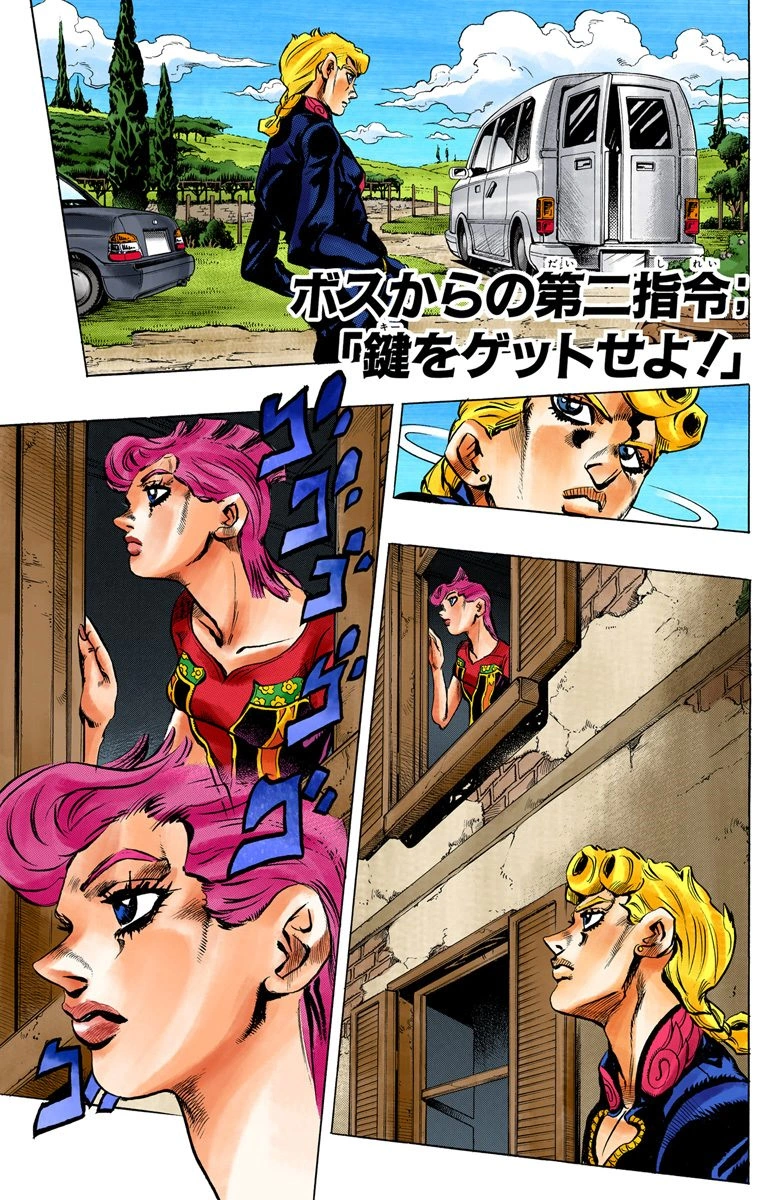
Abilities/Special Powers:
➥ CHARISMA. One of Giorno's preeminent characteristics, and one of the first things most people notice about him, is that he's intensely, effortlessly charismatic - a trait quite possibly inherited from his douchecanoe of a dad, although he tends to use his power more for good than for evil. Despite his youth and relative inexperience, he's usually able to charm people into taking him seriously, as evidenced by the fact that he's managed to become don of an organization that in some ways leads an entire country at the tender age of 16.
➥ LEADERSHIP ABILITY. Linked inextricably to the above: Giorno is a very good leader, although this isn't as natural an ability as his charisma. He learns quite a bit about how to lead effectively throughout Vento, but the seeds of success were always there; he manages a good, instinctive balance between listening, directing, and delegating, and utilizes his natural skills to offset his inexperience.
➥ CREATIVE PROBLEM-SOLVING. Giorno will do pretty much any weird goddamn thing to get himself or his friends out of a fix. Part of this is attributable to the "bizarre" in "Jojo's Bizarre Adventure", a canon where large burly men squeeze themselves into ventilator shafts and bubbles are a strategic weapon, but even for JJBA, Giorno's strategies tend to be a lot. He's able to work together well with others, especially Bruno and Mista, to come up with creative solutions to dilemmas, but he's especially adept at using his Stand powers in unique ways to track enemies, isolate danger, create escape routes, regrow body parts, et cetera and so forth.
➥ STREET SAVVY. Giorno can be a suave motherfucker when he wants to be, but it's also worth pointing out that not only was he a criminal from a young age, he aspired to be the Greatest Criminal Ever, a goddamn Gang-Star. As such, he knows what he's doing in the criminal underworld: he's an excellent pickpocket, an adept car- and plane-thief, and perfectly comfortable with, say, engineering an operative's death and making it look like a suicide. He's also familiar with arms, drug, and human trafficking, although he's pretty stridently against all of the above. Basically anything the mob can do, he can do better.
➥ BILINGUAL. Giorno's mother is Japanese, and he lived in Japan until he was about four; therefore I assume he still has some limited grasp of the Japanese language, although he's probably nothing like fluent anymore.
➥ AND FOR GOOD MEASURE: Giorno can stuff his entire ear into his head. Why? We just don't know.
➥ GOLD EXPERIENCE ( REQUIEM ). Gold Experience is Giorno's personal spiritual buddy, his Stand, described variously as a person's fighting spirit or a representation of their psyche. In Giorno's case, Gold Experience could easily be linked directly to his desires and dreams, his "fighting spirit" a manifestation of his desire to end the destructive reign of Diavolo over Passione and, by extension, to end the legacy of his father and disconnect himself entirely from Dio. Because Diavolo is a killer, and Dio is a mass murderer, but Giorno's power is life - the sustaining and creation of it - which makes him an entirely different creature altogether.
Metatextual analysis aside, before breaking down what exactly Gold Experience can do at Giorno's canon point, it's further important to note that Giorno's Stand has ~*~evolved~*~ from its original powerset, thanks to a complicated set of circumstances that is, unsurprisingly, partially Dio's fault. The exact string of events is detailed further in the above background links, but in short form, what happened was that Gold Experience was pierced by the Stand Arrow, causing its power to grow and change drastically. More on this below.
Gold Experience's Abilities:✘ LIFE GIVER. Gold Experience's most basic ability: it is capable of changing any inorganic matter into a living organism. Giorno most frequently creates small animals like lizards, frogs, birds, et cetera, although there seems to be no hard upper limit as to what he can create. He's also capable of creating plant matter and, presumably, bacteria, fungi, and protists as well. Once they are created, Giorno has control over his organisms, controlling how they move and grow. Additionally, when these organisms are attacked, the attacks are reflected back on the attacker, even to the point of death. Giorno does not suffer animal cruelty lightly.
✘ TRACKING. If Giorno obtains a piece of inorganic material that can be linked to a person, he can change that material into an animal that will then function as a tracker for that person. For example, if somebody dropped an earring on the ground, he could change the earring into a ladybug and it would lead him to them.
✘ LIFE SHOT. When Gold Experience's ability is used on the already-living, it has the effect of a) stretching out the perception of time inside a person's body and mind and b) magnifying sensory experiences within the body. For example, under the influence of Life Shot, one might experience accelerated thought processes, extreme disorientation due to the mind moving faster than the body, and heightened pain reception.
✘ TRANSFORMATION. Gold Experience can not only create whole organisms, but can replicate fragments of a larger organism when it is damaged or destroyed. This ability is most often used in a healing capacity, in order to replace or re-form damaged tissue, and kept a lot of really tragic deaths from happening (for a while). However, there are strict limits to Gold Experience's transformation ability. It cannot bring someone back to life once they're dead; it can, however, bind someone's spirit to their dead body, with fairly catastrophic effect. They will be able to continue functioning and be essentially impervious to pain and injury, but will lose body heat, heartbeat, and senses and deteriorate quite quickly. So in other words, Giorno can make zombies.
✘ VERSATILITY / DEV POTENTIAL. Gold Experience has development potential of A, which basically means the sky's the fucking limit. Even throughout Vento Aureo, Giorno hasn't really begun a thorough trial-and-error of what Gold Experience can do, and as such he's likely to continue playing and experimenting with its limits, since he has a curious mind and is a bit of a perfectionist. Some examples of Gold Experience's development thus far are listed here.
✘ STAND CRY. This isn't actually important, but it's cute: Giorno's Stand cry is "muda muda muda (useless, useless, useless)," just like his daddy's. Sometimes he yells it, sometimes Gold Experience does. Sometimes he wry's, just for the heck of it.
Gold Experience Requiem's Abilities:✘ ALL OF THE ABOVE; PLUS:
✘ RESET TO ZERO. Pretty much what it sounds like: after being pierced by the Stand Arrow, Gold Experience Requiem has the ability to "reset an opponent to zero", or, to put it another way, nixing the effect while keeping the cause; the opponent will in essence start an action over and over again, only to be blocked from completing it. This makes Gold Experience Requiem insanely powerful and essentially capable of blocking any attack as long as Giorno has the wherewithal to use his Stand properly. It also taps into some of his more ruthless impulses, because among other things, when Gold Experience Requiem kills someone, they keep dying. Forever. Their death is constantly reset until the end of time. So, yeah, Giorno Giovanna can send you to hell. This reset ability is, however, extremely untested, and so Giorno isn't adept at using it yet.
Third-Person Sample:
This place, it nags at him. Not because it lacks in any creature comforts. To the contrary, if he were a less naturally suspicious person, he might find this place perfectly suitable for longterm habitation, despite the fact that it's really just a pretty prison.
The Don Giovanna is, of course, in the ninety-ninth percentile of paranoiacs, less because he is the Don Giovanna and more because he is Giorno, and before that he was Haruno. He doesn't trust lulls, which are only ever the eye of an everpresent storm. He lives for excess, but only of his own creation, purchase, or theft; unearned riches reek of bribery, of a desire to keep prisoners complicit in their own captivity.
It's unfortunate that the human body (even his) has limits, that human beings can only stay in crisis for so long before they crumble. It feels like his body is betraying him, with the way just a weeks weeks on high alert here leave him exhausted. Here he is, brushing up once more against the limits of his own abilities. He can do almost anything — almost.
So there comes a day when his weariness and anxiety, his desire to plan and escape and plan and restructure and plan, collapse into the face he's presented thus far, of a good-natured but slightly mystified young man with not much to hide. On that day, his wistful smile is a little more tired and guilty than usual and thus at least four times as genuine. He recognizes the danger of this and dares it to meet him head-on, slipping down to the ballroom at four forty-four in the afternoon, with four records tucked under his arm.
The sky doesn't fall, nor does the ceiling. He sighs and puts the music on, slightly disappointed.
The first is one of Abbacchio's old records, an opera that's all upswelling, genuine emotion. He sits and listens to it, doesn't move at all, not even tapping his fingers in time. Abbacchio would consider that an interruption, would hate him for it, and the thought (as realistic as it is) exhausts him.
The second album is the Stones, although not any coherent collection thereof — not an album, not a best-of, not a B-sides collection. More of a randomized connect-the-dots, songs picked haphazardly from a discography that seems to never end. "Love in Vain" makes him frown, but the rest, as odd and disjointed and improbably a collection as they make, relax him.
He turns the volume a ways down for the third. It's blood music, musica della mafia, handed from the 'ndrangheta sideways to Passione and passed off through time, a moody soup of songs about brotherhood, betrayal, famiglia. It reminds him not only of home but of duty, and the last song ends with him feeling refreshed. Himself again.
They're long albums, each of them, longer than average, so it's past dinnertime when he puts the fourth one on. He doesn't play it yet, though. First he casts a critical eye to the room, which for all its relative splendor strikes him as bare. It's the work of a few moments to change things to his liking; nothing can withstand the full force of Dio Brando's son for long, so it's less than a minute before the walls are climbing with roses in all colors, white and red and yellow and black, the light fixtures curled around and wafting the scent of honeysuckle.
The fourth record is pop. Pure pop, some of his era and some beyond, beats that push away mezzo-sopranos and Jagger and the red right hand of the most powerful criminal family in the world, the true successor to a polluted line, purified and reborn. The fourth record is bubblegum, teen pop, sneaking out after dark and wearing things that your parents wouldn't approve of — not that he would know. The fourth album is what he was thinking, idly and occasionally and only in the two months before he got here, about building for himself.
This time, he dances, and all he feels is the beat and the movement. For this space in time, nothing else matters.
First-Person Sample:
[The video starts halfway through a cut-off laugh, the kind of laugh that sounds like the laugher has been laughing for quite a long time and is pretty out of breath. The camera's not facing the laugher, either; it's pointed at the closet, which opens to reveal what might be considered a prophetic garment.]
This is very silly.
[Even now that he's gathered himself enough to speak, it's a struggle. This is just so much silliness in the wake of waves of awful, he can't not react a little giddily.]
This is — I know it's Valentino. I just don't know when. Not anytime before 2001, I know that much, and I've seen 2002's, so — any ideas? It's lovely, but when I get dressed in the morning I like to know how far in the future my outfit is harvested from.
[His giggling's more or less subdued to wry fondness, now.]
This place is a horrible disaster, but can you imagine how much these closets would sell for back in the real world? Millions easily. More. My floor is strewn with McQueens, and I've never seen those, either. Future couture. Hell if I know what to do with this.
[Wait, that's a damned lie. And now the camera turns to catch Giorno's cheerful (sly) expression, with the headpiece nesting carefully on his unpinned curls, a snake wreathing the skull of an angel. Or a fashion demon.]
Everyone meet me in the ballroom in half an hour, or else. We're all learning to walk in McQueen's. Or I'll die of boredom and be very unhappy waking up, so please don't keep me waiting.
